 Saturday, August 29, 2026

Fujifilm and the Future of Print: Why I Have Changed My View
Ray Stasieczko’s recent article asking whether Fujifilm is heading toward an exit from its Business Innovation operation made me reconsider my own view.
Earlier this month, I wrote for RTM World that FUJIFILM Holdings’ proposed partial spin-off of FUJIFILM Business Innovation should not simply be interpreted as an exit from printing. I argued that Fujifilm BI remains a substantial cash-generating business and that greater independence could help it move faster in partnerships, procurement, manufacturing cooperation, and industry consolidation.
I still believe that conclusion is partly correct. But after looking more closely at Ray’s argument, Fujifilm management’s subsequent comments, and other partial spin-off cases, I would now revise my interpretation.
The most important distinction is this:
FUJIFILM Holdings may be preparing to step away from controlling the printing business. That does not necessarily mean FUJIFILM Business Innovation is preparing to step away from printing.
In fact, greater independence could make Fujifilm BI a more aggressive participant in the consolidation of our industry.
Why “Less Than 20%” Matters
Fujifilm announced on August 6 that it is considering a partial spin-off of Fujifilm BI within two to three years. Under the contemplated structure, Fujifilm Holdings would retain less than 20%, while distributing the remaining shares to its own shareholders and listing Fujifilm BI on the Tokyo Stock Exchange.
I initially attached considerable significance to Fujifilm retaining a stake. The company says this would allow Fujifilm BI to continue using the FUJIFILM brand and maintain synergies with the group.
But the number itself deserves closer examination.
Under Japan’s partial spin-off framework, the less-than-20% threshold has important tax and accounting implications. Similar structures are well established internationally, often with 19.9% retained initially.
Sony provides a particularly relevant Japanese precedent. In 2025, Sony distributed more than 80% of Sony Financial Group to its shareholders while retaining less than 20%. Sony could then concentrate capital allocation on its core entertainment and image-sensor businesses, while Sony Financial Group gained much greater independence.
Internationally, retained stakes are not always permanent. They can later be reduced or monetized.
Therefore, I no longer believe we should assume that Fujifilm’s planned minority stake represents a long-term commitment to ownership. It may also provide flexibility: maintain the relationship initially, then decide later whether to keep, reduce, sell, or use that holding as part of a larger industry restructuring.
Fujifilm Holdings and Fujifilm BI Have Different Objectives
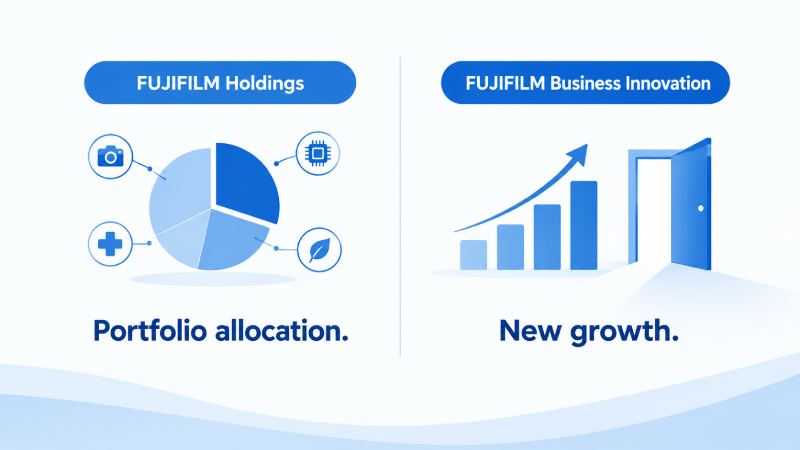 This distinction helps explain what might otherwise appear to be contradictory messages from management.
For FUJIFILM Holdings, the issue is portfolio allocation. Healthcare and Electronics are major growth areas, while Imaging has become highly profitable. Business Innovation operates in a mature market with different growth characteristics and capital requirements.
For FUJIFILM Business Innovation, however, independence creates opportunity.
President Naoki Hama has said that Fujifilm BI wants to accelerate its shift from printing toward solutions. More importantly, discussing the large number of players remaining in the industry and the likelihood of consolidation, he indicated that Fujifilm BI wants to play a leading role in that restructuring.
That statement should not be overlooked.
As a wholly owned subsidiary, major acquisitions, mergers, or capital alliances ultimately sit within the capital-allocation framework of Fujifilm Holdings. As an independently listed company, Fujifilm BI would have its own equity, financing capacity, governance, and valuation.
That gives it substantially greater freedom to buy businesses, merge with competitors, form alliances, or restructure manufacturing.
The spin-off may therefore perform two functions simultaneously: an exit from control for the parent, and greater strategic freedom for the subsidiary.
The Film Analogy Has Limits
Fujifilm’s history naturally invites comparison with photographic film.
When digital photography arrived, demand for photographic film collapsed dramatically. Fujifilm recognized the structural change early, restructured aggressively, and transferred technology, people, and capital toward healthcare, advanced materials, and other businesses.
Printing is different.
Office printing is undoubtedly declining, but it is not experiencing anything comparable to the speed of the collapse in photographic film. Fujifilm’s own market analysis shows continuing declines in A3 MFP shipments and much faster declines in page volumes, but a substantial installed base will remain for many years.
That difference creates time for consolidation.
There will still be hardware, service contracts, toner, ink, parts, maintenance, production printing, and document solutions. The number of competitors may decline much faster than the market itself.
In such a market, being one of the survivors can still be attractive.
So the lesson from photographic film should not simply be “exit before the market disappears.”
It should be: recognize structural decline early, consolidate capacity, find the segments where you can still win, and redeploy capital before decline forces you to act.
Fujifilm vs. Xerox + Lexmark
Whether Fujifilm BI can actually lead industry consolidation will depend partly on brand and distribution power. And here geography matters enormously.
In the United States, Xerox is clearly the stronger business-printing brand. Fujifilm only began selling Apeos office MFPs under its own brand in the U.S. in 2024. Japan and Asia-Pacific are almost the opposite.
Fujifilm reported approximately 28% share of A3 color MFP engines in Japan and 23% in Asia-Pacific excluding China in FY2023. These markets inherit the customer relationships, sales organizations, and service infrastructure built over decades by Fuji Xerox.
This means it is misleading to take the American perception of the FUJIFILM brand and apply it globally.
At the same time, Xerox has changed the equation by acquiring Lexmark for approximately $1.5 billion in 2025. The combined organization serves more than 200,000 clients in more than 170 countries, significantly strengthening Xerox’s geographic reach, including in Asia-Pacific.
We are therefore entering a fascinating new phase.
Fujifilm is moving west. Xerox, strengthened by Lexmark, can move east.
The outcome of that competition will influence Fujifilm BI’s ability to become a consolidator rather than eventually becoming part of another OEM bloc.
What Happens Next?
Fujifilm says any spin-off would be approximately two to three years away. That points roughly toward 2028–2029, if the plan proceeds.
Before then, I would expect Fujifilm BI to focus heavily on profitability, restructuring production and sales operations, expanding solutions, and demonstrating that it can operate as an independent listed company.
After listing, the possibilities widen considerably. Fujifilm Holdings could maintain its minority stake. It could gradually sell it, as seen in overseas spin-offs. Fujifilm BI could acquire another player, merge with one, enter a manufacturing alliance, or participate in a broader restructuring of Japanese OEM production.
Ray has specifically suggested Ricoh and ETRIA as a possible destination. I initially considered that scenario too aggressive. I now think it deserves more attention, although there is still no evidence that this particular outcome has been decided.
Fujifilm BI could become a buyer.
It could become a merger partner.
Or ultimately it could become part of someone else’s bloc.
The important change is that independence would make all of those options easier.
The Lesson for the Aftermarket
This is why I think the Fujifilm case matters to aftermarket companies.
We normally discuss consolidation in terms of cartridges, chips, firmware, common engines, and manufacturing scale. But we should also think about ownership.
Sometimes the best owner of a mature business is no longer its current owner.
My own company has experienced this on a much smaller scale. Last year, QRIE agreed to transfer our corporate B2B business, mainly related to toner products and components, to ST Imaging. The transfer was completed in January 2026.
QRIE did this so we could concentrate management resources on e-commerce and our newer businesses.
What has pleased me greatly is that the transferred business has performed even better under ST Imaging. With greater freedom and a different organizational environment, the business is thriving.
Of course, QRIE and Fujifilm operate on completely different scales. But the principle is similar.
Releasing ownership does not necessarily mean abandoning a business. Sometimes it gives that business more freedom to succeed.
My previous article concluded: “Manage the decline. Win the remaining market. Fund the next growth engine.” I still believe that.
But I would now add one more line: “And when necessary, change the ownership structure so that both the old business and the new one have the freedom to win.”
Ray’s article helped deepen my understanding of Fujifilm’s move. The question is no longer simply whether Fujifilm is exiting print. The more interesting question is: When the next round of consolidation is complete, will Fujifilm BI be a consolidator, a partner, or part of someone else’s bloc?
For the aftermarket, that is worth watching very closely.
About Author
 Koichi Yoshizuka is the founder and CEO of QRIE Ltd., established in 2005. QRIE specializes in importing and wholesaling compatible inks and toners for printers. The company has successfully expanded its online presence through its e-commerce site and major platforms, including Rakuten, Amazon, and Yahoo! Shopping, serving a diverse clientele that ranges from corporate clients to individual consumers. Renowned for quality and affordability, QRIE has won Rakuten’s Shop of the Year award in the Electronics category three times.
In addition, QRIE is actively developing new digital businesses and products driven by employee innovation. Today, QRIE boasts annual sales revenue of approximately USD 14 million and employs 45 dedicated staff members. Under Koichi Yoshizuka’s leadership, QRIE continues to thrive and innovate in the competitive printer supplies market.
Koichi Yoshizuka was also a featured speaker at the RemaxWorld Summit 2024, held in October during the RemaxWorld Expo in Zhuhai, China. In his address, he highlighted the unique characteristics of the Japanese printing and copying market.
For communication, you can contact Koichi Yoshizuka on LinkedIn.
Other posts from Koichi:
- Fujifilm’s Planned BI Spin-Off Offers a Lesson for the Imaging Aftermarket
- If Epson Is Moving Beyond Printers, Why Shouldn’t We Move Beyond Cartridges?
- Canon Marketing Japan’s Valuation Surge: Lessons for the Aftermarket
- What ASKUL’s Pivot Teaches Us About Surviving a Shrinking Market
- Japan’s Journey to Paperless: Digitization and the Decline of Office Printing
- The Inevitable Decline of Postal Services in a Paperless World
- How Tokyo’s Digital Reform Threatens Japan’s Office Supply Industry
- Japan’s Digital Address Revolution Reshapes Logistics
- Japan Post’s ¥370 Billion Logistics Overhaul: Implications for QRIE and the Wider Printing Supplies Industry
Comment:
Please leave your comments below for the story “Fujifilm and the Future of Print: Why I Have Changed My View.”


Leave a Comment
Want to join the discussion?Feel free to contribute!